
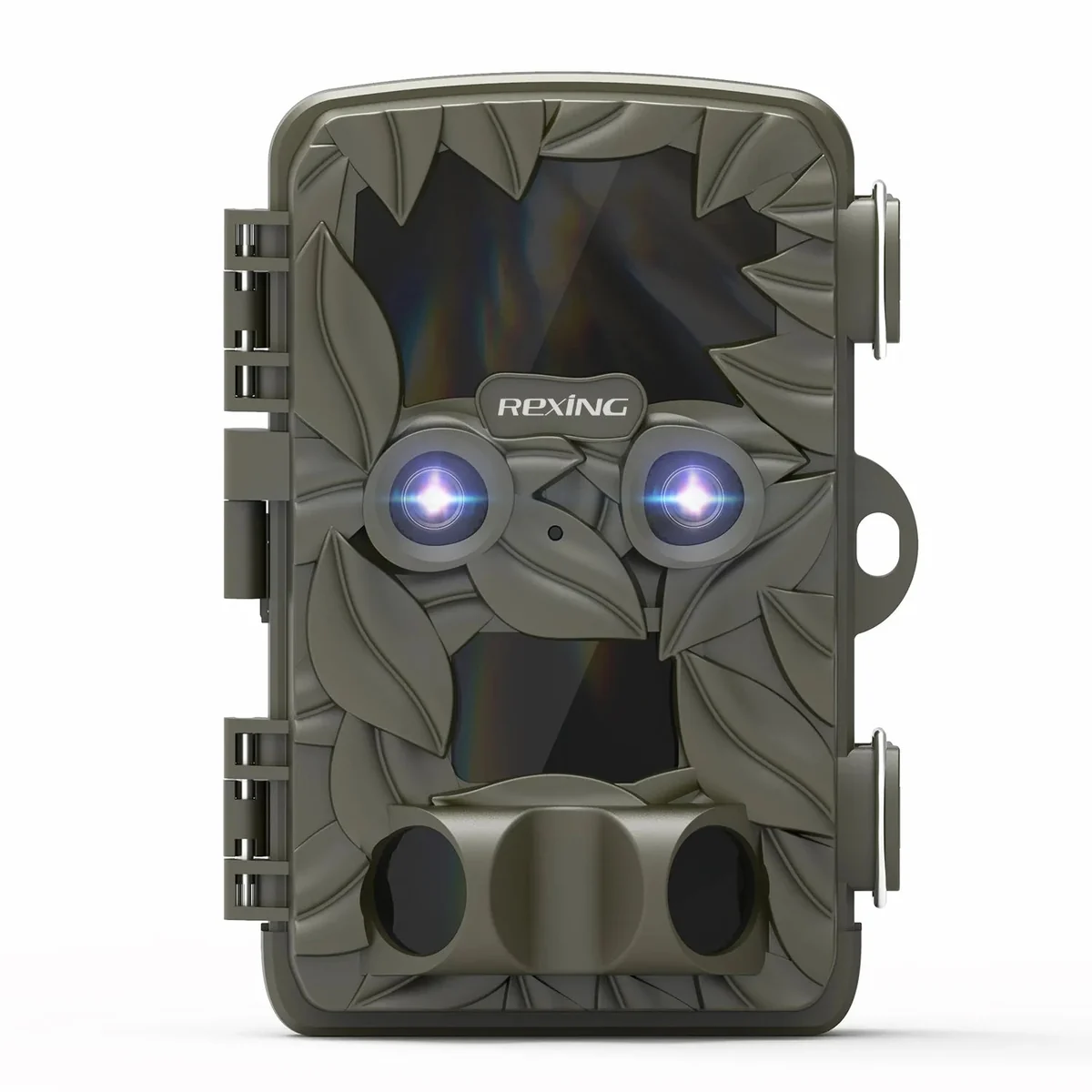
What the documents establish
| Feature | Documented information |
|---|---|
| Imaging arrangement | Separate day and night cameras |
| Advertised video modes | 4K daytime and Full HD infrared nighttime |
| Local viewing | 2.4-inch display; wired playback options |
| Memory | microSD up to 512GB in the manual |
| Internal power | Eight 1.5V AA cells in the manual |
| Wireless delivery | No cellular or Wi-Fi delivery established by the reviewed H6 sources |
The product listing identifies 850nm illumination, but its range and detection-angle descriptions are inconsistent: text and graphics use different figures. We do not use those maximums to rank the H6. The generic specifications on an older Rexing landing page also conflict with the model-specific manual, so that block is not treated as an authoritative H6 configuration.
Understand the dual-camera proposition
A separate day and night path makes it especially important to inspect paired examples. Aim at the same small capture area and compare daylight and darkness files. Check whether the framing changes, whether a subject is sharp while moving, and whether nearby branches overwhelm the night scene. Do not assume that an attractive daytime clip predicts equally useful nighttime identification.
The manufacturer presents the design as avoiding an IR-cut switching sound. We cannot independently verify its acoustic behavior or how animals respond to it. That claim should not replace an assessment of the actual recording task. A camera that documents the entrance and exit of a deer clearly is more useful than a quiet mechanism producing an unhelpful angle.
A local-recording routine, not a remote notification system
Plan a service route before mounting the H6. For this review, there is no documented basis to treat it as a cellular camera or promise off-site app access. The fact that the device has more than one imaging component says nothing about network connectivity. If timely delivery is essential, compare it with connected cameras rather than waiting for a function the H6 sources do not establish.
Card retrieval can still be the better arrangement for a frequently visited property. Keep a spare approved card, label the location and maintain a simple archive of original files. A consistent date and time setting will help when comparing activity with other cameras. Our camera fundamentals guide explains why detection, capture and delivery are separate stages.
Balance video length against the information gained
Longer clips can show how an animal uses a trail, but they also create more files to review and a larger workload for the camera. Start with the shortest recording that answers your question, then extend it if you consistently miss important behavior. The highest recording mode is not automatically the most effective default for every placement.
In a controlled first test, walk at the near, middle and far portions of the expected crossing. Inspect originals on a larger screen and note the camera settings used. Repeat at night without moving the mount. This provides a useful installation baseline; it is not a standardized comparison with another model. Avoid turning a single successful walk test into a general claim about detection reliability.
Power, weather and the exact accessories
The H6 manual specifies eight AA cells, while the product page makes long standby claims with differing durations. Neither gives us a measured service interval for your image volume and temperatures. Schedule the first check conservatively and record what the camera actually captured. Compare battery sets only when the settings and deployment demands are reasonably similar.
Rexing names the H6 on its universal solar-panel compatibility list. That is a reason to ask for the correct kit, not permission to fit an arbitrary panel. Confirm the exact camera revision and connection requirements before ordering accessories. Keep a power problem separate from a card or framing problem when troubleshooting; changing several variables at once makes the result difficult to interpret.
The buying decision
The H6 has a clear place on a shortlist for readers who want to assess a dual-camera local recorder and can revisit the property. Its strongest documented distinction is the day/night arrangement. Its most important unresolved questions are practical image quality, service interval and the conflicting marketing figures.
Ask for the model-specific manual before purchase and verify card compatibility. If possible, buy on terms that allow a proper setup check. We would not pay more solely for a maximum resolution or angle claim. Choose the model when its workflow suits the property and the first recordings demonstrate the detail you actually need.
Straight answers
Frequently asked questions
Does the H6 record 4K at night?
Rexing describes separate 4K daytime and Full HD infrared nighttime recording. Do not read the 4K headline as a claim that both imaging paths record 4K.
Does the H6 require a cellular subscription?
No cellular service is established for this model in the reviewed sources. It is assessed here as a local microSD recorder.
How many batteries does it use?
The model-specific H6 manual specifies eight 1.5V AA cells. Check the current unit manual for approved battery chemistry and accessories.
Is the H6 range independently verified?
No. Rexing publishes inconsistent maximum-range and detection-angle figures, and we have not measured performance.
Sources & verification
Sources checked October 29, 2026. Product revisions, service terms and seller offers can change. Source observations are not our own test results.
- Rexing exact product listing
- Rexing H6 user manual
- Rexing H6 landing page (inconsistent generic specification block excluded)
More from the journal