
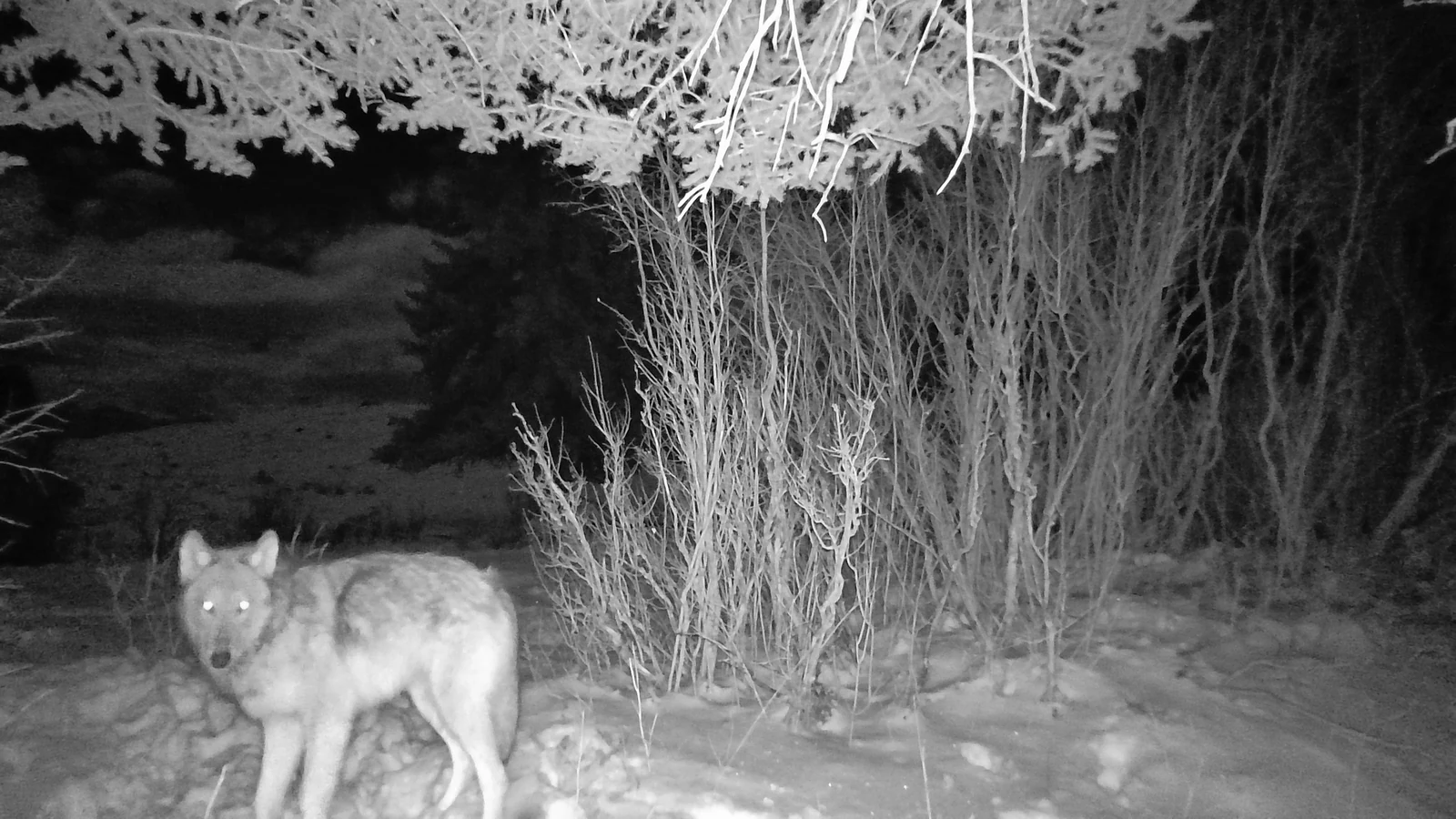

Choose the night image you actually need
Infrared trail cameras illuminate the scene without the obvious burst of a conventional white flash. The two familiar labels are low-glow and no-glow. They describe the illumination approach, not a complete guarantee of image quality, animal response or invisibility.
Begin with the purpose of the camera. Is your priority a discreet installation, clear moving animals at a modest distance, or color documentation at night? A useful choice accounts for the whole imaging system. The longest advertised flash distance cannot tell you whether a moving animal will be identifiable at that range.
What 850 nm and 940 nm mean
In SPYPOINT's terminology, low-glow LEDs use 850 nm infrared illumination and no-glow LEDs use 940 nm infrared. The wavelength is outside the main visible range, but low-glow arrays can show a faint red glow when active. No-glow designs reduce that visible signature.
SPYPOINT's comparison provides the terminology. Treat the label as a starting classification. LED output, optical design, exposure control and sensor sensitivity still differ among cameras.
| Illumination | Typical nighttime result | Question to ask |
|---|---|---|
| Low-glow infrared | Monochrome image; array may show faint red glow | Is the visible signature acceptable here? |
| No-glow infrared | Monochrome image with reduced visible LED signature | Is moving-subject detail adequate at my distance? |
| White flash | Color can be recorded with visible illumination | Is the obvious flash suitable for the purpose? |
Do not confuse discreet illumination with guaranteed stealth
A camera can be noticed for reasons unrelated to wavelength. Its shape, mounting position, human disturbance or mechanical sounds may matter. Different animals and circumstances also prevent a universal prediction about reactions.
For that reason, avoid promises that no-glow cameras never disturb wildlife. A discreet installation combines sensible placement and limited disturbance with an appropriate illumination system. Evaluate the recorded behavior at your own site rather than assuming the label settles the issue.
If several animals repeatedly stop and look toward the unit, record the conditions before changing hardware. Consider aim, distance and visible obstacles as well as illumination. One animal looking at the camera is an observation, not proof of a wavelength problem.
Night range and identification range are different
Flash range indicates a manufacturer's claimed illumination reach under its conditions. The distance at which you can reliably identify a moving animal may be much shorter. A pale tree trunk can remain visible after an animal's useful detail has disappeared.
Evaluate motion blur, not just scene brightness. Exposure decisions trade brightness, noise and movement. A camera can produce an attractive empty night scene yet blur a crossing deer. Original files with moving subjects at known distances are more useful than a single carefully chosen marketing frame.
Compare illumination uniformity as well. A bright central hotspot with dark sides is a different tool from a broadly lit scene. For your own evaluation, walk across the center and edges of the intended route. Test what the camera records rather than judging only how bright the LEDs look to you.
Fix foreground reflections before buying another camera
A close branch, pale rock, post or trunk may reflect disproportionate light toward the lens. Inspect the first few feet of the scene. Change the foreground clearance or aim, then compare a new night sample using the same settings.
Keep the lens and illumination window clean using the manufacturer's recommended method. Check for moisture and condensation rather than assuming every hazy image is an exposure fault. Confirm approved batteries, because nighttime illumination places demands on the power system that daytime capture may not reveal.
Where the camera allows flash-power settings, test them at the real animal distance. Maximum output is not automatically best for a close crossing. Make one change, record it and inspect the effect. This preserves a useful explanation for the improvement or failure.
How to compare sample footage fairly
Look for footage identified by exact model, mode and date. An older version's night scene does not establish the performance of its replacement. Compression on a video platform can hide noise and fine detail, so a demonstration is supporting evidence rather than a substitute for original files.
A manufacturer video can explain features; an independent video may reveal practical compromises. Neither creates a universal ranking. Use matched conditions when possible: similar distance, movement, background and settings. Choose the camera whose tradeoffs fit your site, and retain enough time to test its actual night performance before relying on it.
Straight answers
Frequently asked questions
What is the difference between no-glow and low-glow trail cameras?
The main distinction is the visible signature of their infrared illumination. SPYPOINT describes low-glow systems as using 850 nm LEDs and no-glow systems as using 940 nm LEDs. Low-glow arrays may show faint red light during capture. Actual image detail, reach and motion performance depend on the complete camera, not wavelength alone.
Do no-glow trail cameras take color pictures at night?
Conventional no-glow infrared trail cameras normally record monochrome nighttime images. A color-looking result may involve ambient light, a separate visible-light system or software colorization. Check how the specific model produces that result. Do not treat an artificially colorized image as proof of the original colors of an animal or object.
Can deer see a no-glow trail camera?
A no-glow label does not establish that a deer cannot notice the camera. It describes reduced visible LED glow. Animals may respond to the unit, its location or the disturbance associated with installation. Avoid absolute claims about every deer and every setting; watch the behavior recorded at the site over repeated encounters.
Is low-glow always better for nighttime image quality?
No. Wavelength is only one part of nighttime imaging. Compare the actual camera models for exposure, illumination coverage, motion blur and useful subject detail. A brighter scene is not necessarily a sharper moving animal. Use original sample files and a realistic subject distance whenever they are available.
Why are nearby animals washed out in my night photos?
A close animal or reflective foreground object may receive or return more infrared illumination than the exposure can handle well. Move the camera or change its aim to increase working distance and remove near obstructions. If supported, test a lower flash setting. Keep the other settings unchanged while comparing results.
How far can a no-glow camera see at night?
There is no single range for all no-glow cameras. The manufacturer flash specification is not the same as reliable identification distance for a moving animal. Test the exact model at the near and far parts of your intended route. Compare movement and detail rather than deciding from the brightest distant object in the frame.
Sources & verification
Sources checked October 24, 2026. Product revisions, service terms and seller offers can change. Source observations are not our own test results.
- SPYPOINT: Low-Glow vs No-Glow
- SPYPOINT: FLEX-S-DARK illumination options
- RECONYX: HyperFire 4K no-glow model
- Browning: Nighttime Trail Camera Images
More from the journal