
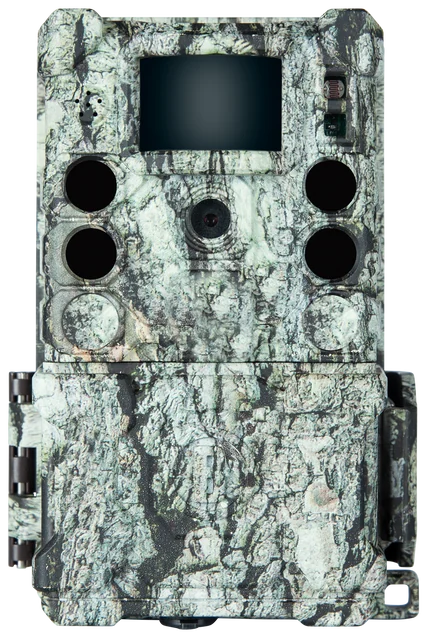
Identify S-4K correctly and keep DS-4K separate
| Item | Documented information |
|---|---|
| Brand and model | Bushnell CORE S-4K; 119949C / BU-119949C |
| Imaging layout | Single sensor; distinct from CORE DS-4K 119987C |
| Listed recording | 4K video and up to 30MP photo output |
| Night illumination | No-glow; advertised 110-foot night range |
| Review screen | 1.5-inch color viewscreen |
| Retrieval | Non-cellular; SD card workflow |
| Manual setup | Six AA lithium or alkaline cells; up to 512GB SD |
Sources: the Bushnell product listing and combined S-4K / DS-4K manual. Use the sections for 119949C; a shared document does not make the two models interchangeable. The seller's brand category is not a reason to rename the camera.
Choose 4K for a file you will actually inspect
Start with how you use the recordings. If your usual review is a quick check on a small display, a larger file may provide little immediate benefit. If you inspect original clips on a larger screen, the recording format becomes more relevant, but exposure, motion and framing still determine whether the subject is useful.
For the trial, choose a defined capture area and record a person moving through it at several distances. Inspect the original files without relying solely on a thumbnail. Keep a note of the selected mode and the conditions so that a later comparison has a clear reference point.
The aim is not to collect the largest possible archive. It is to answer a repeatable question with a file you can read. A well-framed crossing can be more valuable than a wide scene containing a small, indistinct subject.
Understand what the screen and menus do for setup
A local viewscreen can be useful when adjusting an installation, but a brief screen check should not be the end of the test. Check the full original on the device you normally use for review. Confirm that timestamps, framing and saved clips behave as expected before choosing a difficult-to-reach mount.
Begin with a straightforward recording mode and change one setting at a time. If the resulting file disappoints, you can then separate an aiming problem from an exposure choice or a setting you changed earlier. Write down the configuration rather than relying on memory between visits.
Keep a repeatable walk route for future adjustments. When moving the camera, make the same test again. That gives you evidence of what changed at the site rather than a general impression that a new tree looks better.
No-glow is one part of the night decision
Discreet illumination and identifiable moving subjects are separate objectives. Evaluate both at the intended mounting distance. Avoid placing reflective branches close to the lens and check the image after dark rather than extrapolating from the daylight view.
A maximum advertised range should not dictate the whole scene. Begin with the distance at which you actually need to recognize activity, then judge whether the sample answers that question. We have no standardized files that establish the useful night-identification distance for this camera.
Do not infer that an unobtrusive flash makes the complete installation undetectable. Mounting, access, noise, human traffic and the visible camera itself remain part of the site decision. Choose the location around the monitoring task and the permission you have to use it.
Plan retrieval, power and geographic suitability
An SD setup needs a workable collection routine. Before deploying, check the full cycle: record a known event, save the files, review them and prepare the card for reuse according to the manual. Label cards and locations clearly if you run more than one camera.
Use the exact manual for approved batteries and any optional external power. Do not assume that another brand's solar accessory is suitable because the plug fits. Plan an early inspection under the actual workload instead of treating an advertised longevity figure as your servicing interval.
The researched manual expressly says this model is not designed for operation or sale outside the United States, despite also providing a Canadian support number. Canadian readers should obtain explicit advice from Bushnell about the intended product and support region before purchase. Non-cellular operation alone does not settle that restriction.
The buying decision
Choose the S-4K workflow when local originals, careful setup and planned card checks match the job. Compare a connected system when prompt remote information is the central requirement. Compare the distinct DS-4K on its own evidence if its different imaging arrangement is the reason for your interest.
Before ordering the supplied offer, ask the seller to confirm that the boxed product is Bushnell 119949C and check the current firmware instructions for that code. Keep the identification and receipt with your setup notes. The resolved brand name helps you buy the intended camera; your practical trial determines whether it earns its place on the tree.
Straight answers
Frequently asked questions
Is the 119949C CORE S-4K made by Primos?
Bushnell identifies 119949C as its CORE S-4K. The linked retailer uses a Primos category, so verify the box and full model code rather than adopting that label.
Is the S-4K the same camera as CORE DS-4K?
No. The shared manual identifies S-4K as 119949C and DS-4K as 119987C. Use the correct model's sections and specifications.
Does this camera send pictures over a cellular network?
Bushnell lists it as non-cellular. Plan to collect the recordings through the supported local workflow.
Can I assume it is suitable for Canada because it is non-cellular?
No. The researched manual states a US-only operation/sale intention. Ask Bushnell to resolve the intended country and support arrangement before buying.
Sources & verification
Sources checked October 29, 2026. Product revisions, service terms and seller offers can change. Source observations are not our own test results.
- Bushnell CORE S-4K product listing
- Bushnell S-4K / DS-4K instruction manual
- Bushnell firmware page identifying Core-S 4K as 119949C
- Ammunition Depot 119949C offer, categorized as Primos
More from the journal