
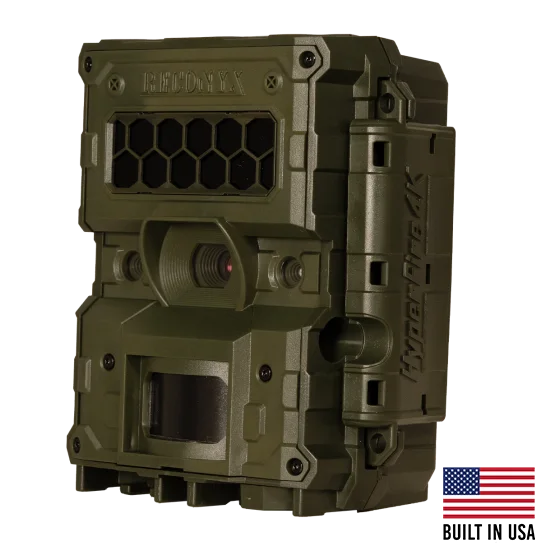
Official specifications
| Item | Verified specification |
|---|---|
| Model | HF4K; non-cellular wildlife scouting version |
| Listed U.S. price | $399.99 on RECONYX when checked October 24, 2026 |
| Recording | Native 4K images and video |
| Night illumination | NoGlow covert infrared |
| Assembly | Manufacturer states built in the USA |
| Warranty | 5 years; conditions apply |
| Battery configuration | 12 AA |
| Approved battery choices | Energizer Ultimate Lithium or high-quality NiMH per manual |
| Storage | SD cards up to 1TB |
Primary sources: official product page and HF4K scouting user guide. This review does not describe the HF4KC cellular version or HP4K professional version.
What native 4K changes
Native resolution is more informative than a large output-megapixel badge because it tells you the recorded format is not simply being promoted through a much larger interpolated image. It still does not guarantee sharp moving animals in darkness. Optics, exposure, subject size and lighting remain part of the result.
Think about the file you want to inspect. If the purpose is identifying an animal and logging a pass, a less expensive camera may be enough. If you want to examine a larger original image, preserve useful video or document several species, the format has a clearer role. Decide what extra information you expect to gain rather than treating 4K as a universal reason to upgrade.
On a long deployment, larger files also change the archive routine. A card can hold more than you want to sort in one sitting. Organize folders by camera, site and card-check date, preserve originals and keep exported clips separate. That makes a season's record more useful when you revisit a question months later.
No-glow night recording and placement
No-glow illumination is valuable when a visible emitter glow would be undesirable. It does not make the housing invisible or guarantee that every animal ignores the installation. Strap placement, silhouette and the frequency of human visits can still matter. Keep expectations tied to the complete setup.
For night recordings, clear close foreground vegetation before interpreting the image. A bright nearby branch and a distant dark animal create a harder exposure problem than an open, modest-distance scene. Aiming slightly along the direction of travel gives more opportunities than putting a narrow crossing at the extreme edge of the frame.
Subject movement deserves special attention when viewing samples. A perfectly still animal can make almost any exposure look better than a walking one. Look for feet, head edges and fine features during movement. Decide whether the image answers your actual question rather than merely whether the background looks impressive.
Power and storage demand a deliberate plan
The official manual is unusually explicit about approved batteries: use the specified lithium or suitable NiMH options and do not substitute alkaline cells. Set the battery type correctly. The camera's status interpretation needs to match the installed chemistry. Mixing cell types or dropping old cells into a fresh set is a poor basis for evaluating runtime.
Video workload must be budgeted separately from still-photo workload. A quiet site taking occasional pictures is different from repeated night videos at a busy crossing. No calendar-life claim can cover both. Start with a short deployment, inspect the resulting workload and adjust the power plan from observed use.
The guide supports up to 1TB, but its recommendations for typical photo and 4K video use are smaller than that ceiling. Choose a compatible card for your actual task and keep a second card available for swaps. Disarm and power off before removing it. External power also requires the correct electrical specification; a matching-looking connector is not enough.
Independent evidence and the owner-report gap
In its firsthand HF4K review, Trailcampro praises daylight images and lists video battery life, menu wording and the loose external-power cover among its cautions. That is useful inspection guidance. It is the retailer's testing and experience, not ours, and it is not a statistical survey of owners.
We did not find enough clearly identified, independent owner reports for this exact non-cellular revision to claim a repeated reliability pattern. A current Habitat Talk discussion covers cellular Reconyx use. Transmission and plan comments from that thread do not belong in an HF4K non-cellular verdict, even when participants shorten the product name.
Evidence quality matters more than filling a pros-and-cons box. Ask an owner for the precise model, capture mode, service interval and deployment conditions. A positive review after a weekend and a winter-long record answer different questions. Long-term non-cellular HF4K ownership remains a useful topic for future submissions with original files and dates.
Is the premium worth paying?
The five-year warranty is a substantial part of the proposition, but read its conditions and confirm who handles a claim in your country. A long warranty cannot restore an observation period lost while a camera is being serviced. For a critical project, redundancy and a service schedule may be more valuable than putting the entire budget into one expensive unit.
At the listed price, this camera needs an explicit job. If your only requirement is knowing whether a deer passed last week, the Command Ops Elite 40 or a similar local-recording camera may leave more budget for coverage. If you want a compact conventional option with useful viewing features, compare the Strike Force Pro X 1080. The Reconyx proposition becomes stronger when native recording, no-glow operation and manufacturer support address priorities you can name.
For U.S. and Canadian buyers, confirm currency, tax, shipping, regional warranty handling and returns. There is no carrier-plan compatibility problem to solve on this SD-only model, but buying across the border can still complicate support. Request a complete delivered price before comparing a Canadian retail offer with the U.S. manufacturer price.
Pros, cons and final recommendation
| Reasons to shortlist | Reasons to pause |
|---|---|
| Native 4K local recording and no-glow IR | Premium initial purchase cost |
| Five-year manufacturer warranty | No remote image delivery or camera status |
| Explicit battery and card guidance | Twelve approved AA cells and a realistic video power plan |
Our conclusion is conditional: shortlist the HF4K when your recording requirements justify its price and you accept manual servicing. Keep the total deployment budget visible: camera, approved cells, cards, reader, security and travel. Test the entire setup before an important unattended period, retain a baseline set of originals and judge the camera by useful observations rather than marketing resolution alone.
Straight answers
Frequently asked questions
Does the Reconyx HyperFire 4K need a monthly plan?
The HF4K non-cellular scouting model does not need a cellular plan. It stores files on an SD card that you retrieve at the site. Reconyx also sells cellular 4K cameras, so verify the complete model code when shopping; this review does not cover those transmission features or plans.
Can I use alkaline batteries in the HF4K?
The HF4K scouting manual does not approve alkaline cells. It specifies Energizer Ultimate Lithium or suitable high-quality NiMH and warns about battery-related damage and warranty conditions. Follow the current guide for your unit, choose the correct battery setting and use a matched set rather than mixing chemistries or old and fresh cells.
What SD card should I buy for Reconyx HF4K video?
The official guide permits up to 1TB and recommends a high-speed 128GB or 256GB card for 4K video. Check the current compatibility guidance and your intended recording workload before buying. Keep a spare card for field swaps, and disarm and power off the camera before inserting or removing it.
Does native 4K guarantee sharp night videos?
Native 4K describes recording resolution, not a guarantee against movement blur or difficult lighting. Judge night footage with moving subjects at the distance you expect to use. Exposure, illumination, subject speed and reflective foreground objects all influence whether the resulting detail is useful for identification.
Is the HF4K worth more than a budget trail camera?
It can be if native local recording, no-glow operation and the five-year warranty solve specific needs. A nearby basic scouting location may be served adequately by a less expensive SD camera. Compare the entire deployment budget and the cost of servicing the site, then choose according to the information you need to collect.
Sources & verification
Sources checked October 24, 2026. Product revisions, service terms and seller offers can change. Source observations are not our own test results.
- RECONYX official product page
- RECONYX HF4K scouting guide
- Trailcampro firsthand HF4K review
- Cellular forum discussion, explicitly distinguished
More from the journal