
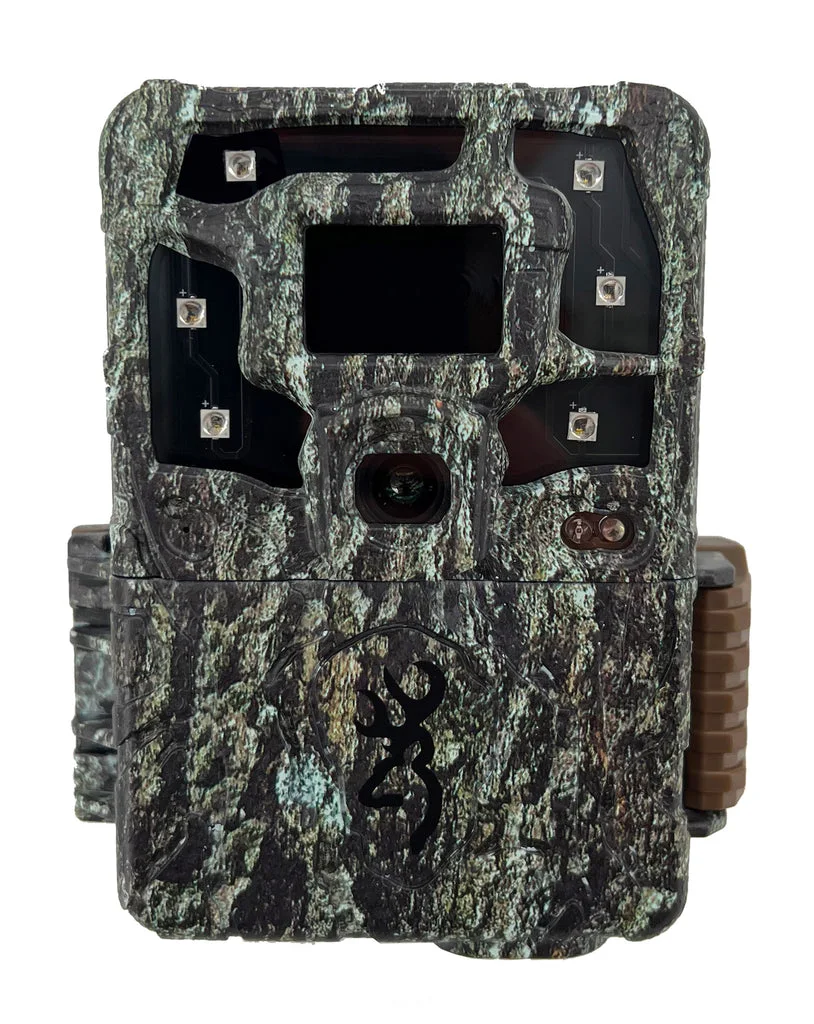
Official specifications and the revision question
| Item | Verified specification |
|---|---|
| Model | BTC-5PX-1080 |
| Listed U.S. price | $139.99 when checked October 24, 2026 |
| Connection | Non-cellular SD-card camera |
| Image output | Product page: 24 MP; 2026 comparison chart: 46 MP - verify revision |
| Video | 1080p with sound |
| Claimed trigger / recovery | 0.22 / 0.35 second on product page |
| Night flash | Low-glow IR; claimed 120-foot flash range |
| Viewing | 1.5-inch color screen |
| Storage | Up to 512GB SDXC |
Sources: official product page and 2026 chart. A conflict is shown rather than silently resolved.
Where the design earns its place
The strongest reason to step above a basic camera is field setup. A viewing screen helps reveal whether the camera is aimed at the travel corridor or mostly at empty sky. It also makes a bad angle easier to correct before leaving. A small display cannot establish fine focus or prove that a fast subject is sharp; inspect original files on a larger screen after the first short deployment.
The adjustable steel bracket gives a deliberate way to change tilt. That is preferable to repeatedly disturbing a strapped camera while guessing at the angle. Choose a solid trunk and tighten the strap evenly. Leave clearance for the latch and battery servicing, particularly if you intend to use a separate security box.
For a nearby lease, farm or cabin, a no-subscription workflow can be an advantage. You can archive the original files directly and avoid managing image-plan allowances. The price is delayed knowledge: until you check the card, you cannot distinguish a quiet trail from a camera that was accidentally left in setup mode or lost power. Regular visits remain part of the system.
Detection is more than the fastest printed number
Trigger speed describes only one stage between an animal entering a detection zone and the resulting file. Recovery determines whether a following animal or a return pass is recorded. Mounting angle determines how much time the animal spends in view. A fast unit aimed poorly can still produce partial bodies or empty frames.
Avoid assuming that the headline photo number applies to video. In its firsthand review, Trailcampro reports separate photo and video behavior, praises the detection circuit and notes useful mounting and viewing features. Those are that tester's observations, not our measurements. The review concerns a tested revision, so it should not erase the specification conflict in newer manufacturer material.
Our practical recommendation is a walk test in both directions at the intended subject distance. Inspect the first frame, not simply the fact that the unit triggered. Repeat with your normal capture mode. A video-focused setup and a photo inventory setup may justify different compromises even on the same camera.
Night images and honest expectations
This is a low-glow camera. The emitter can be visible as a red glow, so choose a no-glow alternative when emitter visibility outweighs the benefits of this model. Do not infer that the 120-foot flash claim means detailed antlers on a moving deer at 120 feet. Illumination, detection and identifiable detail are separate limits.
Evaluate motion blur before enlarging night photos. If the animal is moving during a long exposure, a larger output image preserves the blur at a larger file size. That is why a clear, modest-size original can be more useful than a high-megapixel file with soft detail. Camera-to-subject distance and reflective foreground vegetation can change the result substantially.
Keep nearby branches away from the intended view, avoid pointing at a reflective fence post immediately in front of the unit, and test the night scene. The first inspection should answer a defined question: can you identify the animal, count the group or judge the feature you actually care about? A pleasing woodland background is secondary to that task.
What owners and independent testers actually say
A Reddit owner preparing this exact model for pasture video asks how much card capacity is appropriate for checks roughly a week apart. That is a useful example of an ownership question, not a reliability verdict. Activity level and video settings have to be known before anyone can estimate the right service interval.
Older Strike Force discussion should stay separate. A 2017 discussion contains both positive impressions and criticism about older Strike Force HD cameras. We do not transfer those claims to the Pro X 1080. Similar family names are not a substitute for matching the model code.
Trailcampro's own review notes a battery-eject control that takes effort and cautions about temperature readouts. These are useful items to examine on your unit during the return period. They do not establish a fleet-wide failure rate. A trail camera's temperature stamp should not be treated as a calibrated weather-station record.
Power, storage and lifetime cost
Keep a camera service log with capture mode, battery changes, card checks and any missed periods. Long video and frequent nighttime events can make a battery claim based on still photos irrelevant to your use. For winter deployment, check the current manual's allowed battery types and test the complete setup before leaving it unattended.
Card capacity should fit the planned workload. The listed maximum is not a recommendation that every user needs the largest card. Two compatible cards, a reader and a regular archive routine can be easier to manage than one large card that remains in the camera for months. Avoid silently overwriting observations you intended to retain.
Compare ownership cost as hardware plus power, cards, security and travel. If you already visit the property, the manual workflow may be inexpensive. If every card pull demands a long dedicated trip, the best comparison is against a cellular camera that actually has service at that location. Neither approach is automatically cheaper in every use case.
Pros, cons and who should buy it
| Strengths to weigh | Trade-offs to accept |
|---|---|
| Local originals without image-plan fees | Physical visits are required |
| Viewing screen and adjustable bracket | Low-glow emitter visibility |
| Compact scouting format | Revision details need checking; no remote status |
Choose the Pro X 1080 when the practical setup features solve a real problem and the property is accessible. Choose the Command Ops Elite 40 when lower initial cost matters more than this feature set. Consider a premium no-glow model when you can explain why its particular image, warranty or deployment features justify the extra expense. Confirm the revision first, then buy against the job you need done.
Straight answers
Frequently asked questions
Does the Browning Strike Force Pro X 1080 send photos to a phone?
This model records to an SD card and does not provide cellular photo delivery. You retrieve the files at the camera. A phone can still be used to view copied files with a compatible reader, but that is different from receiving images remotely over a mobile network.
Is the Strike Force Pro X 1080 24 MP or 46 MP?
The manufacturer product page reviewed here lists 24 MP, while the 2026 comparison chart lists 46 MP under the same model family. Confirm the exact packaged revision with the seller and use its matching manual. We do not combine conflicting listings into a single claimed specification.
Is the Strike Force Pro X 1080 no-glow?
Browning identifies the Strike Force Pro X 1080 as low-glow IR in its comparison chart. The infrared emitters can show a red glow. If emitter concealment is a priority, compare a model explicitly labeled no-glow, such as the corresponding Dark Ops offering, and verify its other specifications separately.
What should I test before leaving this camera in the woods?
Check timestamps, card recording, capture mode and the complete view of a person walking the intended route in both directions. Inspect originals rather than relying only on the small screen. Also verify that the unit arms correctly after setup, the case closes cleanly and your battery type matches the current manual.
Why can the advertised flash range be longer than useful night detail?
Flash range only describes claimed illumination reach. Subject movement, exposure, distance, reflections and image processing determine how much detail remains useful. Judge the camera using moving-subject night files at your intended distance. Do not treat a lit silhouette at the edge of the range as proof of identification quality.
Sources & verification
Sources checked October 24, 2026. Product revisions, service terms and seller offers can change. Source observations are not our own test results.
- Browning product page
- Browning 2026 chart
- Browning 2026 model support
- Trailcampro firsthand review
- Exact-model owner storage question
More from the journal