
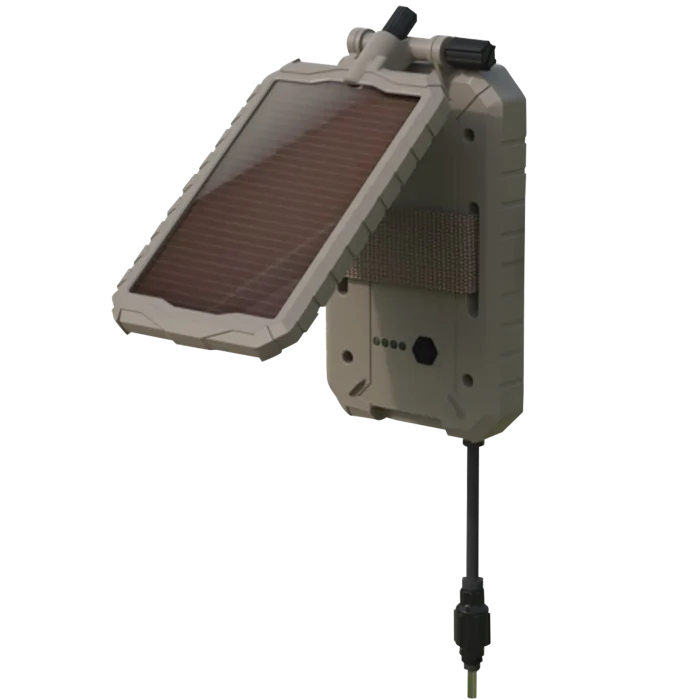
What is documented, and what conflicts
| Item | Documentation |
|---|---|
| Exact product | HME-SOLP5X / retailer SOLP5X; UPC 888151047361 |
| Listed capacity and output | 5000mAh; 12V output |
| Connection features | Threaded connector and 4.5mm adapter |
| Listed compatibility examples | Selected 12V models from Stealth Cam, Muddy, WGI, Browning, SPYPOINT, Moultrie and Tactacam |
| Cable-length conflict | HME page says 4 feet; retailer says 10 feet |
| Housing / security | Weather-resistant housing; Python-lock mounting provision |
Use the HME product page and exact retailer listing to identify the item. Ask which cable and adapters are in the shipped package. Brand-level compatibility language is not approval for every model carrying that brand.
Compatibility starts at the camera input
Write down the camera's required external input voltage, connector dimensions, polarity and any manufacturer restrictions. Then check all of them against the power accessory. A plug fitting into a socket does not prove that the electrical arrangement is correct.
For a recently revised camera, use its own manual rather than an older family description. A product line can contain different power interfaces. Ask the camera manufacturer to confirm the exact accessory combination if its approved list is unclear.
Also check how the camera handles internal batteries when external power is connected. Do not assume that an accessory can recharge whatever cells are already inside the camera. The correct installation procedure must come from the supported combination's documentation.
A capacity figure is not a deployment forecast
The stated milliamp-hour capacity describes one part of a power system. It is not a measured number of photographs or days of operation. A meaningful comparison also depends on battery voltage, conversion losses, usable capacity, load and the way the system manages low power.
Think in terms of demand and replenishment. A quiet photo installation and a busy video installation may have very different needs. Long nights and frequent cellular work can change the balance again. We do not assign an autonomy estimate without those conditions and measured evidence.
Track behavior during the first deployment. Record camera workload, weather and power-status indications. If the system cannot recover after a sequence of poor-light days, more sunlight, less workload or another approved arrangement may be needed.
Place the panel for light, the camera for pictures
The best camera angle and the best solar exposure may be on different parts of the tree. Evaluate both before choosing a mount. A panel under dense foliage can remain shaded while the camera has an excellent view of the trail.
Inspect the likely light path over the part of the season you intend to use. A brief patch of midday sun during setup is not the whole picture. Branches, terrain and changing foliage can affect how long a panel receives useful light.
Route the cable without putting strain on the connector or leaving a loop where a passing animal or a maintenance visit can snag it. Leave the equipment serviceable, and check that the cable reach is sufficient before tightening the final mounts. The conflicting listed lengths make that last check especially relevant here.
Weather and winter need an operating plan
A weather-resistant enclosure is not a substitute for following charging and temperature instructions. Obtain the accessory's permitted charging conditions before planning a cold-weather installation. We have not verified a model-specific minimum charging temperature from the public product information.
Inspect the connections after initial exposure and keep seals clean during servicing. Make the panel accessible enough to inspect for snow, debris or movement. A remote system still needs a realistic response when the power status stops behaving as expected.
Plan a check after poor-weather periods rather than promising continuous power from an ideal sunny-day setup. That is a maintenance choice, not a claim that this particular product will fail in a given condition.
How to compare it with other power options
Compare compatible complete systems, not disconnected capacity numbers. For a nearby camera, replacing approved batteries may be simpler than adding hardware. For a high-maintenance location, a suitable solar arrangement may justify the mounting and inspection work.
Make the decision with a short checklist: exact camera approval, correct electrical interface, sufficient reach, suitable light, accessible mounting and a trial under the intended workload. Confirm the package contents while returns are straightforward.
Read our battery, solar and winter guide before choosing between accessories. The SOLP5X is a possible solution for an appropriate 12V setup; it is not a universal upgrade for every trail camera.
Straight answers
Frequently asked questions
Can the SOLP5X power every camera from a listed brand?
No such blanket compatibility is established. Match the exact camera's voltage, connector, polarity and approved accessory requirements.
Is the supplied cable four feet or ten feet long?
The manufacturer and retailer pages disagree. Confirm the contents of the seller's current package before relying on either length.
Does 5000mAh tell me how many days the camera will run?
No. Runtime also depends on voltage, usable energy, losses, camera workload, sunlight and operating conditions.
Will it charge the AA cells inside my camera?
Do not assume that. Follow the exact camera and accessory instructions for internal batteries and external power.
Sources & verification
Sources checked October 29, 2026. Product revisions, service terms and seller offers can change. Source observations are not our own test results.
How we research reviewsMore from the journal